Educational Asset
Physics: Nuclear & Particle PhysicsPhysics: Optics & Wave Mechanics
No reviewsDe broglie wave equation
#Education#Productivity
Free

Keep exploring
Author

Rating
Views
Acquisitions
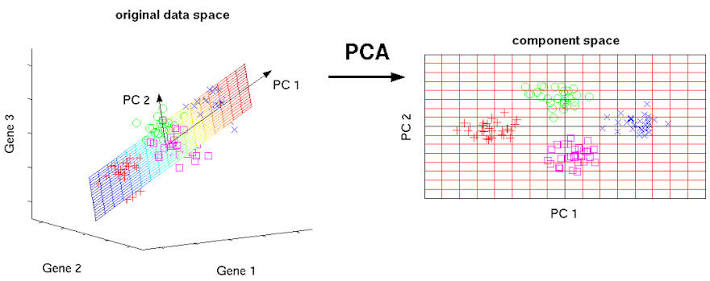
A practical guide to dimensionality reduction using PCA. Learn how to compress high-dimensional datasets (100+ features) into 2-3 principal components without losing critical variance. Includes: mathematical intuition (covariance matrices, eigenvectors), implementation patterns (scikit-learn, TensorFlow), when to use PCA vs. other reduction techniques (t-SNE, UMAP), and production gotchas (scaling requirements, interpretation challenges). Real examples: image compression, feature engineering for faster models, visualization of complex datasets. Code snippets for training/inference pipelines.
Acquired by 41 practitioners
# 1. Import Required Libraries
# =========================================
# 1. Import Required Libraries
"PCA is fundamentally asking: "If I had to throw away 90% of my data, what 10% would preserve the most information?" It does this by finding orthogonal directions of maximum variance. The counterintuitive part: those directions are almost never single features—they're linear combinations that mix everything together. This is why PCA is powerful and why it breaks feature attribution."
Be the first to experience this. Early adopters shape the community and help the creator improve.